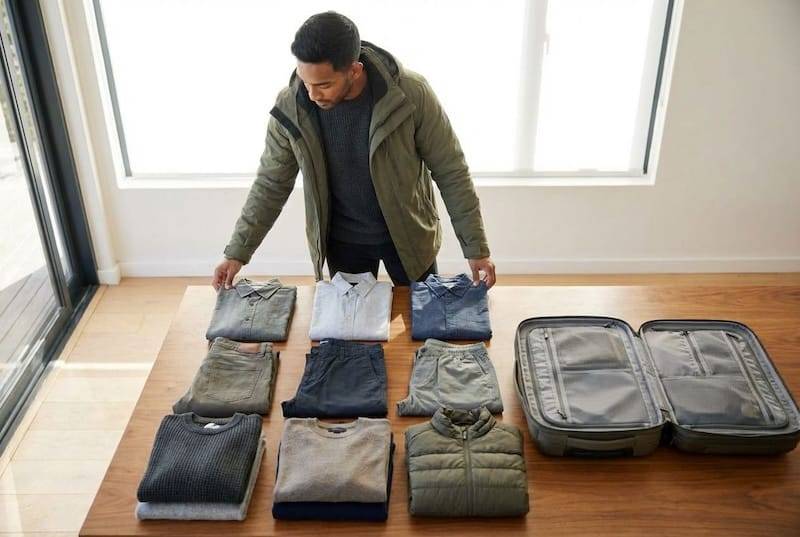
Ever opened your suitcase and thought, why is everything buried, and why do none of these outfits go together? The sudoku packing method approach fixes that by giving you a simple grid you can follow, like a puzzle you already know how to solve.
You pick a small set of clothes that all mix and match, then you pack them in a way that stays organized from day one to the trip home.
I’m going to walk you through the exact steps: how to choose your nine (or sixteen) pieces, how to roll and fold without a pile of wrinkles, and how to use packing cubes so you can actually find what you need fast.
Key Takeaways
- Use the sudoku 3×3 packing method (3 tops × 3 bottoms × 3 layers) to create 27 outfit combinations from nine versatile pieces.
- Use a hybrid approach for space and wrinkles: roll casual knits and tees, fold structured pieces, and keep categories separated with packing cubes and zip pouches.
- Pick a tight color palette (2 to 3 neutrals plus 1 accent) so every top works with every bottom, and your layers multiply your outfits instead of duplicating them.
- Scale up to a 4×4 packing method for longer trips, and use a quick checklist or our free printable sudoku packing method example grid to spot gaps before you zip your bag.

What is the Sudoku Packing Method?
The Sudoku Packing Method is a capsule-wardrobe system that uses a grid to plan outfits before you pack. Instead of tossing clothes in and hoping it works out, you choose a small set of pieces that combine cleanly, then you pack them so they stay easy to access.
Most travelers who use this strategy start with a 3×3 grid: 3 tops, 3 bottoms, and 3 layers. For longer trips, you can use a 4×4 sudoku packing layout with 16 pieces, which gives you more variety without turning your suitcase into chaos.
You can download out free sudoku packing method pdf template or create your own by sketching a grid on paper.
DOWNLOAD your FREE Packing List
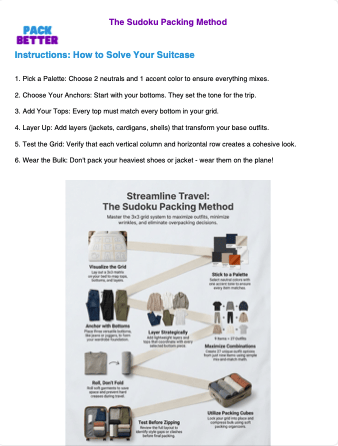
Sudoku Packing Method template
Master the art of the carry-on with this grid-based system designed to turn nine simple pieces into twenty-seven unique looks. This template eliminates the “just in case” panic, ensuring every item in your bag works harder so you can travel lighter.
What makes this method work is that the grid is a decision filter. Every piece has a job, and if it doesn’t mix with the rest, it doesn’t earn space in your bag.
- Rows = categories: tops, bottoms, and layers (or dresses, shoes, and accessories if that fits your trip better).
- Columns = coordination: each column should build complete outfits without “special-case” items.
- Rules = fewer regrets: each item should work in at least 2 outfits, and ideally 3.
- Reality check: the grid should match your itinerary, not your fantasy self.
Once you plan it this way, packing gets calmer, getting dressed gets faster, and you stop hauling duplicates “just in case.”
How the Sudoku Packing Method Works
You’ll get the best results if you plan the grid first, then pack to protect that plan. Think of it as building a mini closet you can actually use out of a suitcase.
- List your “real” days: travel day, active day, nice dinner, weather swings, and anything that needs a specific outfit.
- Choose your bottoms first: they set the tone and the color base for everything else.
- Add tops that repeat on purpose: each top should match every bottom in your grid.
- Pick layers that transform: one cozy layer, one polished layer, one weather layer (when possible).
- Assign shoes and accessories: keep these tight, they can break a carry-on plan fast.
- Pack in zones: cubes for clothes, one pouch for liquids, one pouch for tech, so you don’t dismantle the grid to find a charger.
Match your grid to the destination, not just the calendar. Humid climates call for breathable fabrics that dry quickly, while cold destinations work better with thin layers you can stack instead of one bulky coat. If weather is unpredictable, prioritize one waterproof or wind-blocking layer that works over every outfit in your grid.
Two travel constraints matter a lot in the U.S.: airline size limits and airport security rules. TSA states liquids, gels, creams, and pastes in a carry-on must follow the 3-1-1 rule (3.4 oz containers, one quart-size bag, one per traveler), so put your liquids pouch where you can grab it quickly at screening.
As of February 2026, these are examples of carry-on size limits airlines publish for U.S. travel (always measure wheels and handles too):

| Airline (Example) | Carry-on max size (inches) | Personal item max size (inches) | What this means for your grid |
|---|---|---|---|
| American | 22 x 14 x 9 | 18 x 14 x 8 | Keep your 3×3 pieces compact, then move toiletries and tech into your personal item. |
| Delta | 22 x 14 x 9 | Must fit under the seat | Use cubes so your grid stays stacked and easy to lift into an overhead bin. |
| JetBlue | 22 x 14 x 9 | 17 x 13 x 8 | Plan your “plane outfit” as one of your layers so you pack one less bulky piece. |
| Southwest | 24 x 16 x 10 | Must fit under the seat | You get a little more space, but a clean grid still keeps you from overpacking. |
| Spirit | 22 x 18 x 10 | 18 x 14 x 8 | Personal-item packing matters more, consider a slimmer shoe choice and tighter layers. |
Packing in a 3×3 Grid
This is the simplest version of the method. The 3×3 grid is small enough for a weekend, but flexible enough for a week if you can re-wear and do a quick wash.
- Start with a tight palette: pick 2 neutrals (like navy and gray) plus 1 accent you love. This keeps your outfits from fighting each other.
- Build the grid on a bed or floor: lay out all nine pieces so you can see the whole plan at once.
- Make every piece “pull its weight”: if a top only works with one bottom, swap it out.
- Use layers as your outfit multipliers: a light jacket, a cardigan, and one weather piece usually outperform extra tops.
- Use a patternmaking mindset: treat the grid like a base pattern, then add interest with one textured knit, one simple print, or one accent color.
- Choose knits and crocheted pieces carefully: a thin knit tee layers beautifully, but bulky crocheted items eat space fast, so keep them lightweight or wear them on the plane.
If you want a quick sudoku packing method example, label your grid like this: tops (A, B, C), bottoms (1, 2, 3), layers (X, Y, Z). Then you can “read” outfits like A1X or C3Y without thinking too hard.
Plane Outfit Strategy
Treat your travel-day outfit as part of the grid. Wear your bulkiest shoes, heaviest layer, and any structured pieces that would otherwise dominate suitcase space. Choose items that are comfortable for long sitting but still coordinate with the rest of your capsule so they rotate into your trip wardrobe instead of becoming “dead weight.”
Combining Tops, Bottoms, and Layers
You don’t need a closet full of clothes, you need clothes that cooperate. Here’s how to make your grid mix cleanly, without surprise mismatches on day three.
- Pick 3 bottoms you’ll actually wear: for most trips, that’s one darker option, one lighter option, and one comfort option (like joggers or a skirt).
- Choose 3 tops that match all bottoms: test them right on the grid, if one doesn’t work with a bottom, replace it now.
- Add 3 layers with different jobs: comfort (light sweater), polish (button-down or blazer-style layer), weather (rain shell or packable jacket).
- Set a shoe cap early: two pairs covers most trips (walking pair plus one nicer option). Add a third only if your itinerary truly demands it.
Footwear Rule of Thumb:
Shoes consume more space than any other category, so most carry-on travelers cap themselves at two packed pairs plus the one worn on the plane. Ideally, choose one versatile walking pair and one option that can skew dressier or activity-specific. If a third pair cannot work with multiple outfits, it probably does not belong in a tight grid.
- Plan one “nice” outfit on purpose: don’t pack random dressy pieces, build one complete look that still mixes back into the grid.
- Use the 54321 packing method when you need more structure: another packing method that uses 5 tops, 4 bottoms, 3 pairs of shoes, 2 outer layers, and 1 accessory set. Use it as an upgrade when the 3×3 feels too tight for your plans.
| Quick check | If you answer “no” | Fix |
|---|---|---|
| Does every top match every bottom? | You’ll skip outfits and over-wear one item. | Swap the odd top out, or adjust your palette. |
| Can at least one layer dress things up? | You’ll pack extra “nice” clothes. | Add a polished layer instead of another outfit. |
| Do you have one weather option? | You’ll buy something you didn’t plan for. | Add a light shell, then remove a bulky duplicate. |
What about Accessories?
Accessories are where your personality shows up without wrecking your packing plan. If the grid builds your foundation, accessories are how you change the look, mood, and formality of the same core pieces.
The smartest travel accessories are small, lightweight, and multifunctional. They take up very little space but dramatically expand your outfit options.
Focus on pieces that can transform rather than decorate:
Scarves: A thin scarf can add color, provide warmth on planes, double as a modesty layer for religious sites, or even work as a light blanket or pillow. Silk or lightweight wool packs especially small.
Jewelry: A few statement pieces change the tone of an outfit instantly. Stud earrings for daytime, one bold pair for evening, and a simple necklace or chain can carry you through most trips.
Hats: A packable hat adds style while solving real problems like sun protection or bad hair days. Choose crushable styles that spring back into shape.
Belts: Swapping belts can make the same dress or pants feel completely different. A neutral belt plus one distinctive option usually covers it.
Bags: A foldable tote or compact crossbody gives you flexibility for shopping days, museums, or dinners without packing a full extra purse.
Sunglasses: Functional and style-defining, especially if your wardrobe is neutral.
The goal is not quantity but versatility. Aim for accessories that work across multiple outfits and occasions. If something only matches one look, it probably does not earn space in your bag.
Accessories also let you adjust to different dress codes without packing separate outfits. A blazer plus bold earrings can turn a casual base into dinner attire. Removing them brings the outfit back to daytime mode.
Add a Pop of Color Without Breaking the Grid
If your capsule palette is mostly neutrals, one intentional color piece can keep your wardrobe from feeling repetitive while still staying mix-and-match friendly.
A lightweight cardigan, scarf, or statement accessory in a single accent color works best. Because it layers over multiple outfits, it multiplies visual variety without adding bulk.
For example:
A bright cardigan over a neutral tee and dark jeans instantly creates a different look
A colorful scarf can make the same outfit feel polished or travel-ready
A bold accessory can signal your personal style without committing to multiple colorful garments
Choose one dominant accent rather than several competing colors. This keeps your wardrobe cohesive while still feeling expressive.
If space allows, wear the bulkiest accent item on travel days so it does not take up suitcase room.
Benefits of the Sudoku Packing Method
The biggest win is that you stop packing by panic. The grid forces a plan, and a plan cuts stress.
You also get a clean way to scale: keep the 3×3 for short trips, move to 4×4 packing method for longer ones, or borrow pieces from a 54321 list when your trip needs more variety.
- Faster mornings: you can see your outfit options quickly.
- Fewer “dead” items: you stop bringing clothes that never get worn.
- Less suitcase disruption: cubes and zones keep your grid intact.
- More confidence: you know outfits work before you travel.
This method is completely style-agnostic. Whether your wardrobe leans feminine, masculine, minimalist, sporty, or gender-neutral, the same grid logic applies: coordinated pieces, repeatable outfits, and layers that change the look without adding bulk.
Maximizing Outfit Combinations
Here’s the simple math that makes this method feel like a cheat code. With 3 tops, 3 bottoms, and 3 layers, you can make 27 combinations, and that’s before you even count accessories.

| System | Core pieces | Outfit combos (tops x bottoms x layers) | Best for |
|---|---|---|---|
| 3×3 grid | 9 | 27 | Long weekends, 5 to 7 days, simple itineraries |
| 4×4 grid | 16 | 64 | 8 to 14 days, mixed activities, fewer repeats |
| 5-4-3-2-1 list | Varies | Depends on what you choose | Trips with strict categories (work, events, lots of shoe needs) |
If you travel in heat, lean into sudoku packing summer choices: breathable fabrics, one sun layer (like a light button-down), and a quick-dry bottom you can wash in a sink and re-wear.
A 2024 University of Alberta textile study on odor sorption and release found polyester tends to hold onto odorants more than fibers like wool or nylon over time, which is why merino and nylon blends can be smart picks when you want to re-wear and simply air things out between wears.
- One thin knit top: layers under jackets, works for day or dinner.
- One button-down: acts as a shirt, a light jacket, or a swim cover-up.
- One “polish” layer: a blazer-style layer instantly upgrades basics.
- One texture piece: a lightweight crocheted cardigan adds interest without extra outfits.
Laundry Strategy for Longer Trips
A small grid can stretch far beyond a week if you plan for light laundry. Quick-dry fabrics allow sink washing in a hotel room, while many accommodations offer self-service machines or affordable wash-and-fold services. Washing one or two core pieces mid-trip effectively resets your wardrobe without increasing what you packed.
Saving Space in Your Luggage
The grid helps you choose fewer pieces, and packing technique helps those pieces take up less room. Pair the two and you get the real payoff: a suitcase that closes easily, stays organized, and doesn’t explode the first time you open it.
If you use packing cubes, look for features that solve real problems. Eagle Creek’s Pack-It cubes are popular because they separate outfits cleanly, and compression-style cubes from brands like Thule can help when you’re tight on space (just avoid over-compressing wrinkle-prone items).
- Pack the frame first: place your bulkiest bottoms and layers at the base of your suitcase so the rest stacks neatly.
- Roll the right items: tees, casual knits, and lounge pieces roll well and fill gaps.
- Fold the structured items: collars, button-front shirts, and stiff fabrics do better folded inside a cube.
- Use one “grab pouch” for TSA: keep your quart-size liquids bag and small essentials together so you don’t tear apart your grid at security.
- Stuff gaps with soft items: socks and underwear stabilize the pack and reduce shifting.
- Wear your bulkiest layer: a jacket or heavier sweater belongs on you, not in the bag.
Pre-Zip Checklist
Before closing your suitcase, run a quick grid check:
- Does every top match every bottom?
- Do your layers work over all base outfits?
- Are your bulkiest items worn, not packed?
- Do your shoes serve multiple outfits or activities?
- Is there at least one weather-ready option?
- Can you dress up at least one outfit if needed?
If you can answer yes to most of these, your capsule is likely balanced and travel-ready.
One last pro tip: if your suitcase looks calm and organized, you’ll also find it easier to repack quickly on the way home, especially after laundry or souvenir shopping.
You can really do this. You can get more outfits from fewer items with the sudoku packing method, and you do it without the usual suitcase mess.
Believe me, once you learn to pack this way, it’s hard to go back!